The Asylum That Time Forgot
👁 Told by a real person — originally shared on Reddit
If you ever come across a Craigslist posting for a live-in caretaker at a private psychiatric estate in upstate New York — double pay, room and board included — keep moving. Do not reply. If a blocked number calls you back about it, do not pick up.
I picked up. I was out of options. My nursing license was suspended, collectors were circling, and I was sleeping on a friend's couch with my belongings in trash bags. When Dr. Arthur Vance sat me down in the wood-paneled library of the place they called the Oakhaven Institute, he never asked to see my credentials. He only asked if I could keep my mouth shut and handle ugly sights.
I signed a non-disclosure agreement thicker than a phone book. At the front gate they collected my cell phone and handed me a crackling two-way radio and a heavy loop of brass keys.
Oakhaven does not resemble any hospital you have seen. It is a stone mansion from another century, ringed by iron fencing and endless pine woods that swallow every sound. No computers anywhere. Patient files are fat paper folders in steel cabinets. The nurses wear starched white uniforms and little caps; in the half-light we must have looked like apparitions.
I told myself it was simply a discreet hideaway for the wealthy. The residents were all people someone had paid to disappear: heirs with drug habits, politicians caught in scandals, daughters from good families who had embarrassed the wrong people.
Then I was assigned to Claire.
She was fourteen years old, kept in Room 3B — a cramped, windowless box on the third floor. Her file said her parents committed her for "acute hysteria" — a label no doctor has used in decades. The truth was uglier: she had caught her rich father with another woman and threatened to tell her mother. That was her illness.
The first evening I carried her supper tray in, she was huddled on her cot in the corner, shaking under a rough wool blanket. Her hair clung wet to her forehead. Her mouth had a bluish tinge.
"Are you here with the restraints?" she whispered.
"No — no, I only brought your dinner," I said, suddenly very aware of the weight of the tray.
Her eyes were sunken so deep they looked bruised. She seized my wrist. Her fingers were ice.
"Please," she begged. "Not the water. I will be good, I swear it. I will not cry. Just not the water."
I had no idea what she meant. Three days later I found out, when my rotation put me on the basement floor.
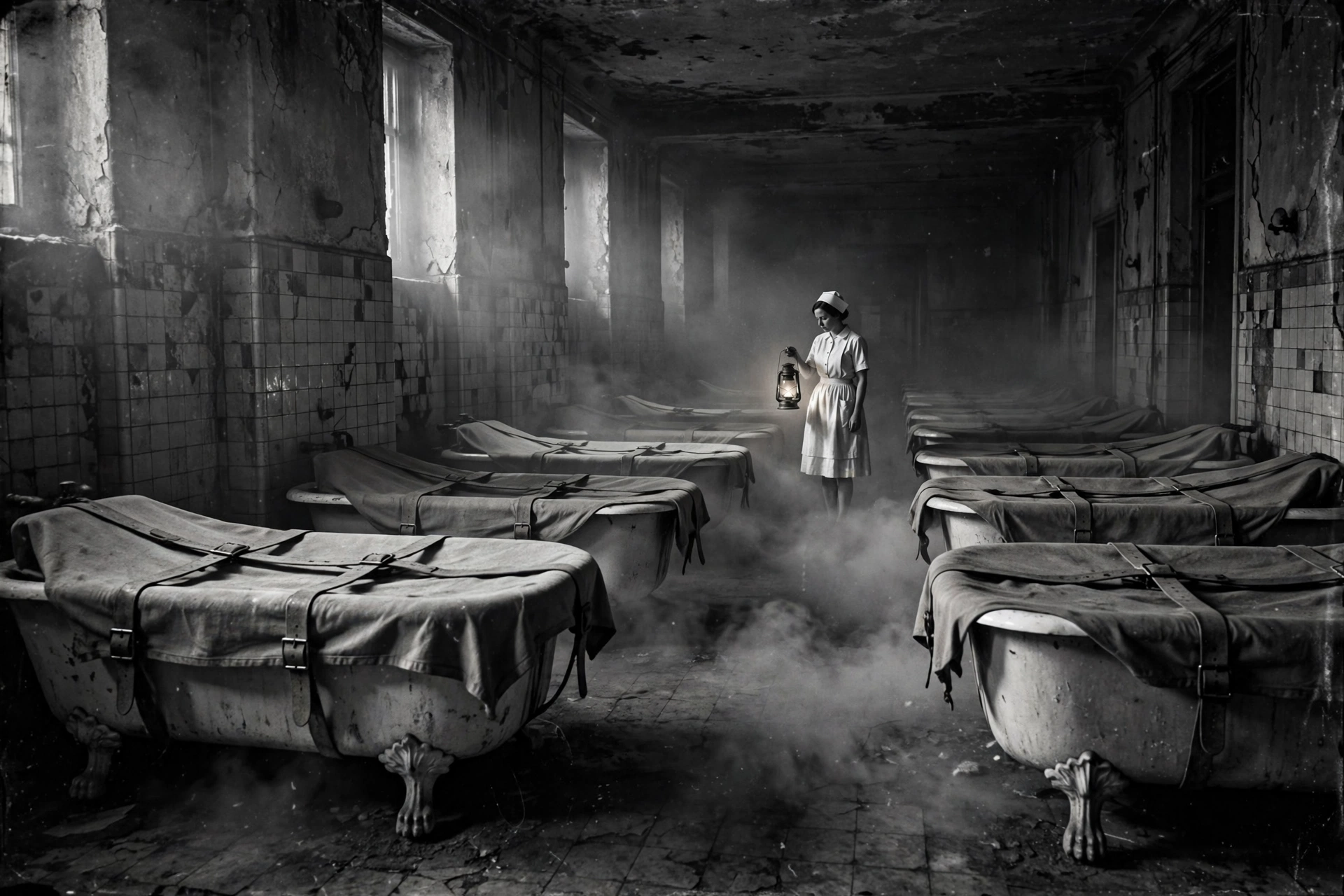
They call it the hydrotherapy wing. I pushed open the heavy wooden doors and the smell hit me first — damp rot, disinfectant, stale sweat. Six enormous porcelain tubs stood in a row.
Every tub held a patient.
They were sunk to their chins in freezing water. Canvas tarps stretched tight across each tub, slit only for the head, buckled with thick leather straps. Teeth knocked together in a ghastly rhythm off the tiled walls.
Dr. Vance stood in the middle of it all, consulting his pocket watch.
"Ah, the new girl," he said pleasantly, sweeping an arm toward the tubs. "Prolonged immersion treatment. A forgotten science. These days they drug patients into stupors with chemicals. But ice water jolts the nerves back into line. It pulls the heat from a fevered mind. It teaches obedience through sheer endurance."
The woman nearest me had been soaking so long her skin was wrinkled white and peeling. Her eyes had rolled up into her head.
"How long have they been in there?" I managed.
"Forty-eight hours, this group," Vance said, jotting something on his clipboard without looking up. "Tomorrow we move them to insulin shock."
Insulin comas. Frontal lobotomies. Electric shocks delivered with no anesthesia and nothing to stop the body convulsing. Oakhaven was not an eccentric clinic. It was a museum of psychiatric cruelty, running in secret, bankrolled by families paying fortunes to bury their embarrassments.
That night I decided: I was getting Claire out.
Then I saw the surgery schedule. Claire's name was penciled in for the morning. The procedure: transorbital leukotomy — the ice-pick lobotomy. Vance ordered it because she wept too loudly at inspection.
At two in the morning I slipped out of the staff dormitory with a crowbar from the gardener's shed and my ring of keys. The corridors were silent but for ticking radiators and, far below, muffled screams from the basement.
I reached the third floor. My hands trembled so violently I dropped the keys twice before the lock on 3B finally turned.
The room was empty.
The cot was neatly made. The thick leather straps hung loose and unbuckled from the bedframe.
My stomach dropped. I took the stairs two at a time down to the basement, not caring who heard. The NDA, my job, my own safety — none of it mattered. I just had to reach that girl first.
I shouldered through the double doors of the operating theater.
The lights were searing. In the center of the room, Claire was lashed to a heavy iron chair. A wide leather band pinned her forehead so she could not turn her head. Her eyes darted everywhere, wild with terror.
Dr. Vance stood over her, no mask, humming some gentle classical melody. In one hand he held a slender steel pick. In the other, a small silver hammer.
He glanced up as the doors banged open — not startled, only faintly let down.
"As I told you," he sighed, laying the hammer on a steel tray. "This work requires a strong stomach."
Two orderlies melted out of the shadows behind me. Before I could turn, one wrenched my arms behind my back and the other seized my hair.
"Let her go, you monster!" I screamed, fighting like an animal. "This is illegal!"
"The law," Vance said softly, strolling toward me, "is for people who cannot afford to ignore it. The families who fund Oakhaven are not buying cures, my dear. They are buying silence. And the old methods are remarkably good at producing silence."
From inside his spotless coat he drew a fat syringe.
"You are clearly suffering from a touch of hysteria yourself," he murmured into my ear. "Do not fret. We keep a bed open for cases like yours."
I did the only thing left to me. I hurled my whole weight backward, stomping down on the orderly's foot, and sank my teeth into the forearm across my throat. He roared and his grip slipped.
I ran.
Vance was shouting behind me. Boots pounded up the stairwell at my heels, but terror is faster than duty. I flung myself through the laundry-room window on the ground floor — glass exploding, my arms shredded — and hit the wet earth outside. I plunged into the tree line and did not stop until my lungs were on fire and the flashlight beams had dissolved into the dark.
Since then I have been holed up in a roadside motel two towns away. I bought a disposable phone with pocket cash and called the police. I told them everything.
The dispatcher left me on hold for ten minutes. When she returned, her voice was flat as slate.
"Ma'am, we show no facility under that name at the address you gave. The owner of that estate called in an escaped patient in severe distress. You are on an untraceable line, so I cannot see where you are. Give me your location and I will send a medical transport to collect you."
I ended the call.
I am writing this on the burner now, while I still can. After I post this, I will probably smash it to bits. My bag is packed. I have to keep moving. But when I close my eyes, I do not see the stained ceiling of this motel room.
I see Claire, tied to that iron chair, waiting for the hammer to fall. She is not crying anymore.
Vance got what he wanted: silence.
Never miss a nightmare
One new horror story in your inbox, every Friday. Plus the free Red Room e-book — three brutal originals, subscribers only. No spam, unsubscribe anytime.
One story every Friday — unsubscribe anytime. We store your email only to send you the newsletter. See our Privacy Policy.
Keep reading… if you dare
Browse more horror
Best horror stories Short scary stories Free scary stories True scary stories Creepypasta stories Best ghost stories Stories to tell in the dark Psychological horror Two-sentence horror