Don't Look Up After 12:03 P.M.
👁 Told by a real person — originally shared on Reddit
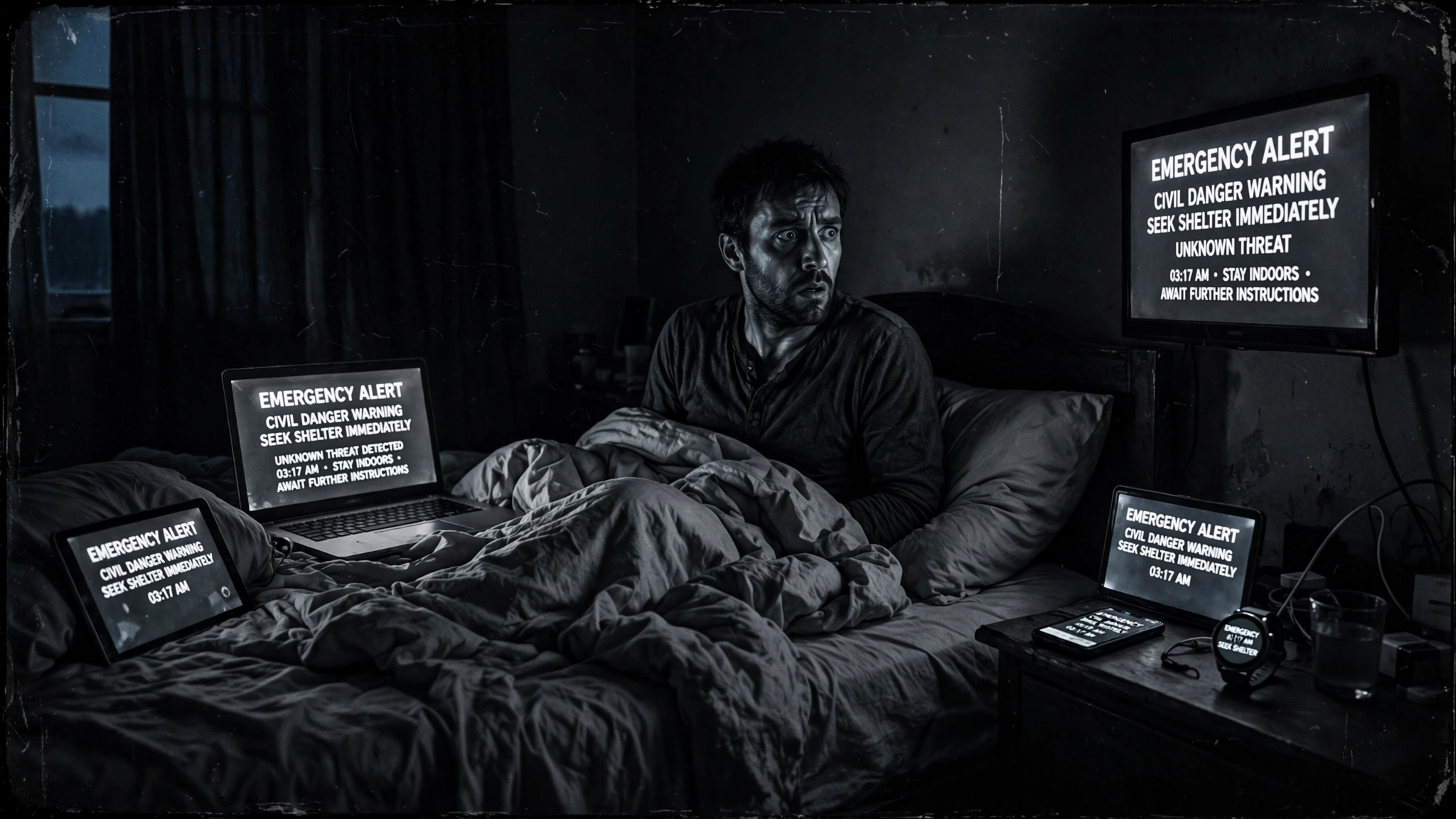
I woke before the alarm — never once in eleven years of marriage — at 5:38 on a Saturday, the fourteenth of November, a date I would come to know better than my own birthday.
One breath later, every device in the house sounded off at once — my phone, the kitchen radio, a hallway smart speaker that had belonged to neither of us for years. Each one, in a voice that belonged to nobody, delivered the same message:
DO NOT LOOK AT THE SKY AFTER 12:03 P.M.
My wife shot upright, fingers clamping around my wrist — the thunderstorm grip. "What is that," she said. It was not a question.
My phone was already drowning in those nine words, in every language I recognized and a few I did not. For eleven years I had worked a job I was forbidden to describe to her, at an agency called Pegasus — a storybook name for people whose business was closer to this: time is not as solid as everyone assumes. I told her it was probably nothing. Neither of us believed it.
By seven the markets were collapsing. A colleague texted from Dulles: twelve planes, gone, no wreckage, nothing on radar. At half past seven, hospitals everywhere reported the same impossible symptom — people forgetting who they were while remembering everything else. The internet called it Whiteout Syndrome. I did not tell my wife I recognized the pattern. I had seen data shaped like this once, in a file I was never supposed to remember reading.
At quarter past eight the tide went out and kept going. The satellites died at ten to nine. At twenty to ten every screen filled with one silent countdown: 02:16:43. My wife watched without crying, and switched off the stove out of habit — no sense letting the house burn down first, she said.
At twenty past ten my phone rang with a number I had not seen in twenty-three years. My mother's voice — exact, present. "Matthew. Are you safe?" Thirty-three seconds. Then the line went dead. At two minutes to eleven the CIA director admitted: "We stopped understanding the data three hours ago." At three minutes past eleven a man seized every channel: "At 12:03 we become husks. Say your goodbyes while you still know the people you love."
My wife looked at me the way she only did when she already knew the answer. "You have known something all morning." "Yes," I said. "I do not think either of us gets a vote on what happens next." She did not ask about Pegasus. She just took my hand. "Then let us go get Olivia."
Our daughter was already awake, curled against her bedroom window. She was nine, and she had never once seen real rain.
"Daddy. When do we get to see it?" "Very soon, my dear."
Thunder rolled a thousand miles off. Olivia climbed onto my shoulders. "This is the first time I will ever see rain," she whispered. "I know," I said, and something in my chest cracked quietly down the middle.
The drops came slow, then all at once. Olivia pressed her tongue to the cold glass, and I held her steady and thought: if this is the last new thing she ever gets, let it at least be this.
"Let me out, Daddy." "I cannot, I am afraid." "Why not?" "We have not found a safe way out yet." "You will. I promise." "Do you promise, Dad?" "Yes, my dear. I promise."
I carried her back to bed, then sat alone in the dark hallway and remembered. A boy who saw shapes nobody else could see. My mother, the only one who believed me — "You will carry a debt," she whispered, dying. Pegasus at twenty-two. A dance floor, a woman in a pink dress. The year we found Olivia. And the day it broke open: Colonel Winston, the thing coming in from beyond the solar system's edge. "The decision is yours," he said. I thought of the message my wife was already carrying, and I said yes. A helmet. A room. "You have one day. She has the message. We need it."
At 12:01, in the hallway, I understood that this day was not new. It was, and would always be, the fourteenth of November.
At 12:03, I did the one thing every human being was told not to do. I looked up.
The sky had gone the color of an old photograph. Everyone who looked saw something different. I saw a dance floor, and a woman's shoes tapping across it. Then a sound came through my bones instead of my ears, and somewhere a window cracked without breaking. And then, silence. The kind with weight.
At 12:05, the memory arrived in every mind on Earth at once: a place with no stars. Being enormous. Being ancient. Not human. And something answered, from inside every human head at once:
YOU WERE THE FIRST.
The world came apart the way a held breath finally does. I held my daughter and my dog under a table and did not let go, and eventually everything stopped moving. Then it rebooted.
I woke in a park I half-remembered, my wife fifteen feet away throwing a ball for a dog that had somehow always been called Tobby. I threw a disc toward the river. "What is wrong?" "Nothing," I said. "Why are you crying?" "Because I do not want to let you go." "Then do not. Stay with me forever." The one promise I had never once managed to keep. "I will not. I will stay here with you the rest of my life."
Somewhere beneath that morning, a room with a helmet in it was already resetting. And every alarm on the planet was tightening its throat for 5:38 a.m.
DO NOT LOOK AT THE SKY AFTER 12:03 P.M.
I always looked anyway. For her. I always would.
There was a version where I kept my eyes on the kitchen floor at 12:03. The silence came anyway. The memory arrived anyway. Looking had never been the variable — it was only ever the thing I was allowed to choose.
There was a version where I begged Colonel Winston to let me skip it all. "The data does not reset because you asked it to," he said. "It resets because you keep finding a reason to come back.
Once, I asked my wife: "Is there something you have never told me." That evening she stopped mid-sentence. "I keep almost remembering something. Like an apology. Or a warning. I cannot tell which." And 12:03 came, and it went back under. I began to suspect the message was not a sentence at all. I began to suspect it was her.
And there was a morning — past the thousandth — when Olivia said, flat, "It is going to rain today. You will hold me on your shoulders and I will lick the glass."
"How do you know that."
"I think I have been here before, Daddy. I think we have been here a lot."
"Yes," I said. "We have."
"Does it always end the same?"
"I do not know yet. But I keep coming back, and you are always here."
"Then it is okay," she said. "As long as you keep coming back, it does not matter how many times."
In one loop Winston told me: "The message is not words, Matthew. What she is holding is closer to a promise than a sentence. I think it was meant to be kept." And: "Maybe the debt was never a debt at all. Maybe it was just this — being asked to love people, fully, knowing you will lose them, and choosing to do it anyway, every single time."
The alarms will start soon. 5:38. Every device in the house, every language at once, the same nine words.
I will lie there and wake up on my own first, a second ahead of the sound. And when her hand closes over my wrist, I will hold her the way I have ten thousand times, and I will not tell her everything.
But I will tell her this much:
"Let us go get Olivia. And let us watch the rain."
The alarm has not gone off yet. I am still ahead of it.
I close my eyes, and do not sleep, and wait.
Never miss a nightmare
One new horror story in your inbox, every Friday. Plus the free Red Room e-book — three brutal originals, subscribers only. No spam, unsubscribe anytime.
One story every Friday — unsubscribe anytime. We store your email only to send you the newsletter. See our Privacy Policy.
Keep reading… if you dare
Browse more horror
Best horror stories Short scary stories Free scary stories True scary stories Creepypasta stories Best ghost stories Stories to tell in the dark Psychological horror Two-sentence horror